The "Investible" Crypto Tokens
Two protocols generate 69% of all crypto holder revenue.
CoinGecko tracks 17 148 tokens.
But how many are actually investible in a current crypto environment that focuses on:
1) revenue to holders
2) revenue even if it doesn’t get distributed. Yet.
3) protocols/tokens will strong narrative & mindshare that might survive a bear market.
I tried to figure this out.
I got most data from the DefiLlama, Coinmarketcap and mindshare protocols (Dexu, Moni, Lunarcrush etc.).
I used Claude Code to do the numbers and reduce my own biases as I would’ve excluded some tokens from this list (like XRP, ADA, BCH… but they survived multiple cycles and have staying power stemming from entrenched liquidity).
Claude still make many mistakes that I debugging took 10x time than writing this article so take the spreadsheet with a grain of salt (link at the end of the post).
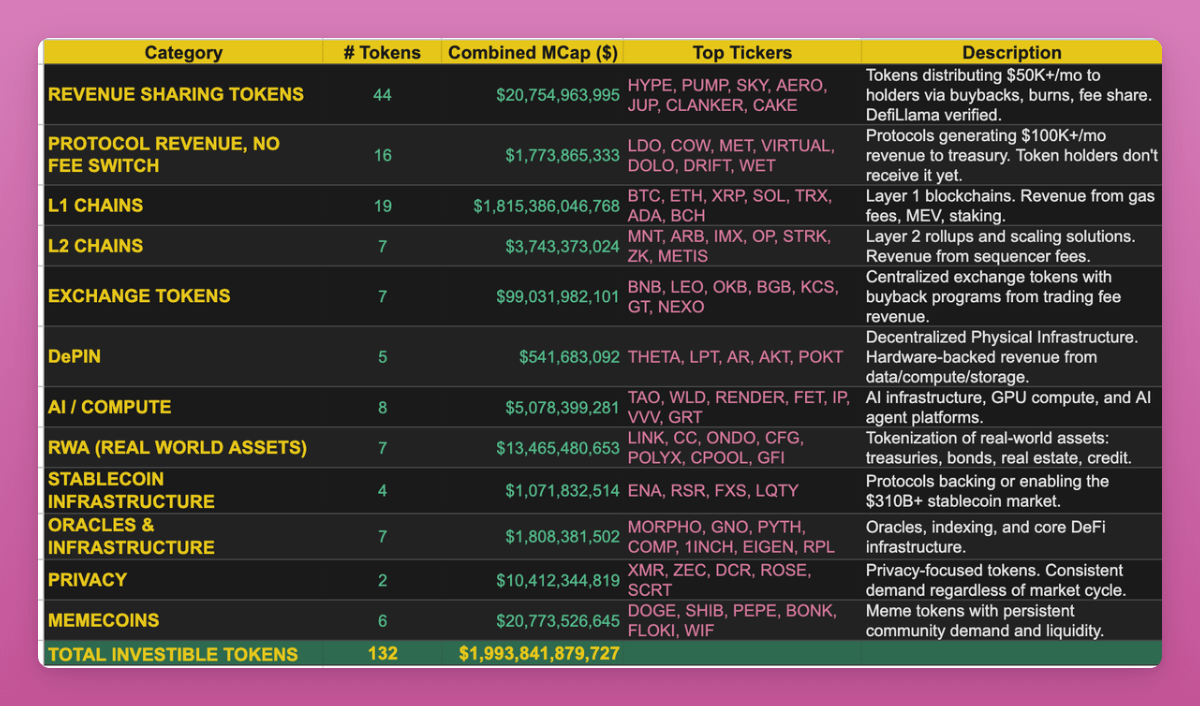
The result: 132 investible tokens across 12 categories. 45 of them pay you to hold (excluded those with very low revenue).
$1.8B annualized flowing to token holders.
The categories are my sole discretion on what I believe can survive and have good future potential. You might disagree with me.
First insight: the investible crypto market is embarrassingly small.
And the tokens that actually pay holders are dominated by just two protocols. More on that below.
Funny, but while working on this list and checking tokens I reached the following conclusion:
But if you are brave enough here are the top investible tokens:
The Top Investible Tokens: Revenue Sharing
The current narrative on CT: if a project has no revenue, it will die! Even ETH is struggling to escape this revenue-based narrative.
Thus the most investible tokens have revenue flowing to token holders in buybacks, burns, fee sharing etc.
I’m generous as the cutoff around $50K in 30-day holders revenue on DefiLlama. These 45 tokens generate $153M per month in holders revenue.
Annualized that’s $1.8B going to people who hold the token.
Top 10 by by revenue sharing:
Note: Revenue sharing is not the same as Holders Revenue on DeFillama. E.g.,EtherFi doesn’t make the Holders Revenue list but they do buybacks. L1s like Tron are excluded and moved to L1 list.
After the top 5, it drops fast to below $3M per month.
If crypto keeps moving toward "tokens as equity," the P/S ratios should matter more going forward.
Pump.fun at 1.4x (note: CMC and CoinGecko show different market caps for PUMP, I used CMC) and Aerodrome at 3.4x are dirt cheap by any tradfi standard.
These are generating revenue at a rate that would recoup their entire market cap in under 3 years.
Meanwhile Uniswap trades at 121x its holders revenue because the market is pricing it more than just on revenue.
Aave sits at 341x. It finally activated buybacks but distributes $412K per month against $10M per month in protocol revenue. Recent governance changes might change the situation.
Cheapest by P/S: Farcaster’s Clanker (0.9x), ORE (0.9x), Yield Basis (0.8x - Andre must be cooking something here), Pump.fun (1.4x), QuickSwap (1.4x).
These are generating revenue at a rate that would recoup their entire market cap in under 3 years.
Most important thing to consider: Hyperliquid + Pump.fun = 69% of all holder revenue!
Two protocols out of 45 generate more than 2/3 of the total cash flow to holders. That concentration is worth thinking about.
Ansem’s tweet is a good summary on HYPE’s investment thesis:
Protocol revenue, no fee switch
16 tokens generating $100K+ monthly in protocol revenue that stays in the treasury.
The biggest: Lido ($4.3M per month with $32B TVL) although rev sharing via staking was proposed last year.
CoW Protocol does $3M per month, followed by Meteora with $2M per month on Solana, Virtuals Protocol ($1.4M per month) and Drift ($868K/mo).
Lido vs ether.fi is an interesting case!
Lido has 10x the TVL and 3x the revenue, but nothing reaches LDO holders.
Ether.fi distributes $1.5M per month via buybacks. If you’re holding through a bear market, you want the one that pays you.
The bet is that these protocols eventually flip the switch.
Lido has been talking about it for years. Jito has $5.3M per month in total fees but only $544K reaches the protocol.
The gap between total fees and holder revenue is the opportunity, and the risk.
The rest of the map
I added exchange tokens (7 tokens, $99B including BNB) because they make money in every market condition. CEX volume drops but never goes to zero.
LEO and OKB barely dumped through 2022 or 2024. BNB at $85B is the heavyweight.
Many do buyback programs are even though they don’t show up on DefiLlama data.
CEX tokens are unique due to high circulating supply, further reducing downside risk.
L1 chains (19 tokens, $1.8T) are the base layer.
BTC at $1.36T and ETH at $245B anchor the category.
I was very generous here for XRP, ADA, and especially Cosmos. I added them becuase they survived multiple cycles and they have believers & liquidity, thus staying power.
You might hate Tron’s TRX but it generates $26m monthly fees - more than Solana or Ethereum. A strong performer this cycle as well! Just check the chart yourself.
L1s will not disappear although valuations will fluctuate by a lot. HODL at your own risk.
AI and compute (8 tokens, $5.1B) is mostly zero-revenue bets, with one exception:
Venice ($293M MC) is the only AI token with a working buyback-and-burn funded by subscription and API inference revenue. 43% of VVV supply has already been burned.
Bittensor at $1.9B MC has 128 subnets and no protocol revenue.
Render and Akash sell GPU compute cheaper than centralized alternatives. Grass ($163M MC) supplies decentralized web data for AI training.
Note: Some of the AI tokens not included in the list are pumping right now. Might be a good trade, but are they ‘investible’ is hard to say.
RWA tokenization (7 tokens, $13.5B) keeps growing quietly and I expect the real RWA bull run is yet to come.
Canton Network ($6B MC) holds $372B in tokenized assets, 88.57% of all on-chain RWA. Yet it is not as simple as it looks with RWAs (perhaps will discuss it in another post).
Chainlink ($6.1B MC) is key oracle for this RWA infra via CCIP. LINK pays stakers rewards, but those come from emissions and a fixed reward pool instead of protocol revenue sharing.
Chainlink generates good rev from oracle feeds, CCIP, and VRF, but that revenue goes to node operators and the Chainlink treasury, not to LINK token holders directly.
Privacy tokens (2 tokens, $9.7B) is a risky bet: they either grow in importance as the world moves closer to 1984, or they get banned and restricted.
Still, consistent demand regardless of market cycle. Monero ($6.2B) and Zcash ($3.6B) are the ones that matter. I could’ve added Railgun but these two cover the narrative exposure, though.
Memecoins (6 tokens, $20.8B) as ‘investible’ might look controversial.
Yet like Bitcoin itself they survive on community. DOGE at $15.2B has been around for over a decade. SHIB, PEPE, BONK, FLOKI, and even WIF made to my list because if markets rebound, they might do better than high revenue tokens.
Why? Because no revenue caps their upside.
I also like them due to almost all supply circulating - less dumping pressure.
Since this getting longer and you can check the whole data on the sheet, I also added:
Seven L2 chains at $3.7B MC combined (Mantle could also be added to Bybit CEX token list though)
DePIN with 5 tokens and just $0.5B is a new category this cycle but they serve unique use-case like decentralized storage and data collection.
Oracles/infrastructure (7 tokens, $1.8B)
Stablecoin infra with 4 tokens at $1.1B. Ethena leads the pack. However investing in stablecoins has been difficult.
The tokenless gap
Some of the most profitable crypto businesses have no investible token at all.
Tether: $6B+ per year revenue. That is more than all 45 Revenue Sharing tokens combined.! All goes to Tether Ltd shareholders.
Polymarket: $3.8M per month in protocol revenue at $400M TVL. No token.
Base: $3.86B TVL, revenue goes to Coinbase shareholders although token is potentially coming.
Phantom: 10M+ users, huuuuge swap fee revenue.
Circle: $56B+ USDC supply but most upside (or downside) was served via IPO :( Circle will launch their ARC chain and might offer great trading opportunities.
Kalshi: $1.13B TVL and CFTC regulated.Also no exposure.
Farcaster has been sold recently, so my high hopes for huge airdrop are dashed. But token is still coming I believe. However, valuation will be much lower.
So… What to do with this info?
The ideal bear market hold has four things:
holders revenue
low P/S ratio but high MC/FDV
and persistent demand.
Very few tokens check all four boxes.
Tokens that come closest:
PUMP (1.4x P/S, 33% MC/FDV but massive revenue)
AERO (3.4x, 50%)
JUP (7.3x, 51%)
SKY (16x, 98%),
CAKE (15.1x, 96%).
For lower risk exchange tokens look good: LEO, OKB, GT are nearly or fully circulating with buyback pressure from exchange profits.
Less upside but the most consistent performers in prior bear markets.
For potentially higher risk and good reward HYPE leads revenue by a wide margin but 25% MC/FDV. Although Coingecko added Outstanding Token Value that excludes tokens that won’t enter circulation anytime soon (and burnt tokens). This drops the MC/FDV ratio to 41%.
Potentially a good trade is look for changes in governance: for Protocol Revenue tokens, you’re betting on the fee switch.
Lido, Meteora, Drift, and CoW Protocol are the ones to watch.
For everything else, it’s conviction.
Do you believe AI compute goes onchain?
Do you believe RWA tokenization keeps growing? I think it will but are those tokens the ones to bet?
If you think I’m missing a token or have wrong data, let me know.
Given how many mistakes Claude made during this process, there are probably more errors to fix. And quite a few tokens I missed as well.
The full list on Google Sheets here.
P.s. Huge shoutout to Coinmarketcap that still gives free API. All others are either paid or give limits.


