Crypto Truths & Lies: Lessons from 2025
Reviewing the 2025 scorecard before we look ahead to 2026
One year ago I wrote Crypto Truths & Lies for 2025.
Everyone was sharing higher Bitcoin targets. I wanted a different framework to look for where the crowd could be wrong and position differently.
The goal was simple: find ideas that already exist but are ignored, disliked, or misunderstood.
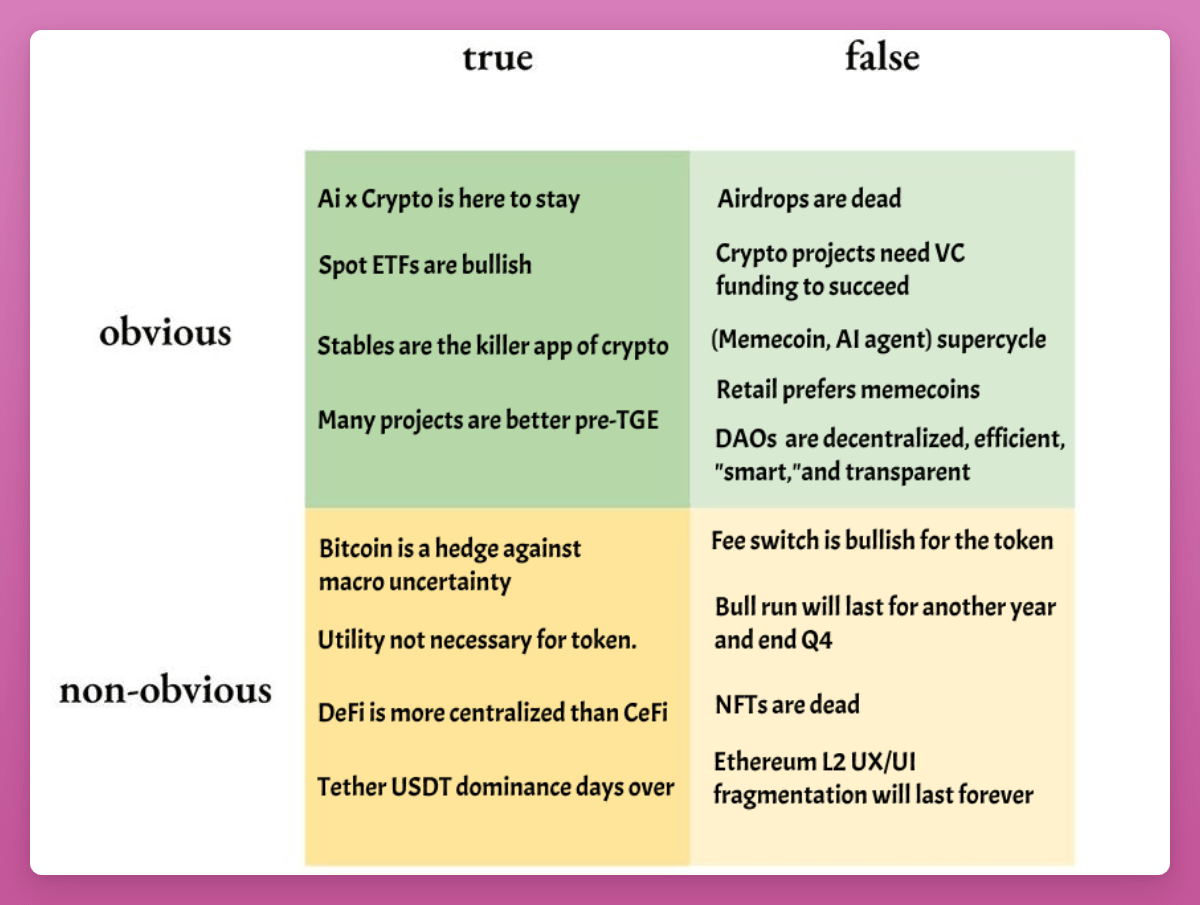
Before I share the 2026 edition, here’s a clean recap of what actually mattered in 2025. What we got right. What we got wrong.
And what we should learn from it.
If you don’t review your own thinking, you’re not investing, but just guessing.
Quick Takes
‘BTC tops in Q4.’
Most people expected it, but it looked too easy to be true. They were right. I was wrong (and paying the price for it). Unless BTC pumps from here and breaks the 4-year cycle pattern, I’ll take the L for this one.
‘Retail prefers memecoins.’
Retail didn’t prefer crypto at all. They bought gold, silver, AI stocks and anything that wasn’t crypto. No meme or AI agent supercycles as well.
‘AI x Crypto stays strong.’
Mixed. Projects continue to ship, the x402 standard bringing crypto to AI together is growing and funding continued. But tokens failed to sustain any rally.
‘NFTs are dead.’
Yeah 😭
These are easy to recap. The real insight was in five bigger themes.
Spot ETFs were the floor, not the ceiling
Bitcoin OGs (long-term holders) sold around 1.4m in BTC from March 2024 alone, valued at $121.17b (Source: WuBlockchain).
Imagine the bloodbath in crypto without ETFs: despite the drop in price, BTC ETF inflows were still positive at $26.9b USD.
The gap of ~$95b is why BTC lagged almost every other macro asset. There’s nothing wrong with BTC itself. I might even claim there’s no need to dig too deep into unemployment, manufacturing or other selective data to make sense of it.
It was just ‘The Big Rotation’ from whales and 4-year cycle believoooors.
Perhaps more importantly, Bitcoin behaved differently to traditionally risk-on assets like Nasdaq. The correlation is the lowest since 2022, currently at -0.42.
Yes, we all expected correlation to break upwards, but it’s bullish long term for BTC as institutions seek uncorrelated portfolio assets.
Overall, ETFs absorbed the supply shocks that used to send us to goblin town.
Even better news, there are signs these supply shocks are gone:
Therefore I feel arrogantly brave to make 2026 price prediction for BTC at $174k USD, which would stand at 10% of gold’s market cap at $5k USD per ounce.
You can make fun of this prediction in 12 months :)
Airdrops are decidedly NOT dead
The deja vu moment is that CT once agains claims airdrops are dead. In early 2025 the sentiment was similar.
If there were dead, I wouldn’t have received 46k USD in Lighter airdrop!
In 2025 alone, we saw nearly $4.5b distributed in major drops. List at their peak value.
Story Protocol (IP): ~$1.4B
Berachain (BERA): ~$1.17B
Jupiter (JUP): ~$791M during “Jupuary”
Animecoin (ANIME): ~$711M
Linea (LINEA): ~$437M
What changed is fatigue for points, sybil detection got better (explaining fake negative sentiment on X towards airdrops), and valuations (that went down).
You also needed to sell all airdrops to maximize returns. The ‘obvious truth’ of 2025 that many projects are better pre-TGE turned out to be also right.
Jumping ahead, 2026 will be a great year for airdrops with MAJOR players getting ready for TGE: Polymarket, Kalshi (maybe?), Metamask, MetaETH, Tempo, Base (?), multiple perp DEXs and many more.
It’s not the year to stop clicking buttons.
But it’s the year to stop blind betting and praying. Airdrop farming requires concentration for big bets.
Fee switch WAS NOT bullish for the token price. It was a floor.
My big non-obvious truth prediction was that fee switch would not automatically pump the token.
In truth, most protocols don’t generate high enough revenue to add significant price appreciation to the token as revenue-to-market cap ratios are crazy in crypto.
As I wrote:
“I believe the fee switch doesn't impact how high the token can pump; instead, it sets a floor price for how low the token can trade. If revenue sharing is active and the revenue is significant, the token becomes worth buying at some point.”
Looking at the top projects by “Holders Revenue” on DeFillama, the picture seems clear: with the exception of $HYPE, all high-revenue sharing tokens are outperforming ETH.
I admit, comparing to ETH might seem unfair, but for most DeFi investors, ETH is the beta every alt has to beat.
What’s especially surprising is the performance of $UNI. Uniswap finally turned the switch on. They even burnt $100M of UNI that would have been burned if the fee switch had been active since the protocol's inception.
UNI first pumped by ~75% but then retraced ALL the gains, ending the year among other DeFi tokens.
To be fair, comparing these high-revenue tokens to my admittedly very subjective, non-high-revenue-sharing tokens below, it seems high-revenue tokens have outperformed on the downside.
Three insights from this:
Token buybacks set a floor, not a ceiling, for token prices.
Everything this cycle was a trade, as shown by UNI’s pre- and post-announcement pump and retracement.
Buybacks is just one side of the story; selling supply has to be accounted for. And most tokens are still low-float with unlocks continuing for years to come.
Stables dominate mindshare but (profitable) stablecoin-proxy trades are hard to find
I was traveling in Bali in December and for the first time I was asked to pay in stablecoins.
The motorbike rent guy just shared his son’s Tron address asking to pay in USDT.
USDT, on TRON?!
Seriously, in the EU I can’t even trade with USDT. It shows how hard it is to replace entrenched players and that the first-mover advantage is helping USDT stay strong.
Having said so, I was right on USDT dominance decreasing: it dropped from 67% to 60%. For me, holding USDT isn’t worth the risk considering their asset allocation structure.
While dominance decreased, USDT market cap still grew. In fact, Citi projects the market cap for stables to grow from ~$280b today to $1.9t (Base Case) or even $4.0t (Bull Case) by 2030.

In 2025 the narrative has shifted from ‘trading’ to ‘payment infrastructure’ to challenge tradfi. And, to the detriment of my bags (Ethereum), Tempo, Stable (scam), Plasma, and many more are coming for the payments playbook.
Trading the stablecoin narrative wasn’t easy, though. Circle’s IPO initially performed extraordinary well but managed to retrace all the gains.
Stable (scam) and Plasma were two other proxy-trades yet aren’t looking good tbh.
The TL;DR of 2025, including stablecoin narrative is that everything in 2025 was just a trade.
I bet you rarely use stablecoins for payments directly… Unless you use crypto cards.

They exploded in popularity partly because of tax evasion convenience bypassing banks and their strict AML requirements.
The end result is bullish block space because every EtherFi card swipe is a transaction onchain.
I dream of a crypto card that grows in dominance and manages to somehow bypass Visa/Mastercard altogether and enable direct P2P payments. This is a 10000x opportunity in crypto.
Payy, Kast, Holyheld are one way or another working towards this. Their TGEs might surprise on the upside in 2026.
DeFi is more centralized than CeFi
This was a daring take by DeFi Made Here (Fluid team) that proved even more important than I expected.
To recap, the centralization isn’t related to blockchain decentralization, or self-custody.
As DMH said “very few protocols have the majority of TVL, very few risk providers that are working for the same projects and have vested interest in each, etc etc)”
Here’s what he meant:
J.P. Morgan has ~12% market share in USA, aave has 50-70% market share
L2s are multibillion unregulated multisigs
Tether is a hundred billion multisig
Chainlink almost solely controls all value in defi
The same risk assessment teams are on paychecks for different protocols and they clearly have a conflict of interest
Etc etc etc
(note: Aave’s TVL dominance stayed same at 63% despite the growth of TVL across all lending protocols)
The business and TVL concentration is denser in DeFi than in CeFi. As USDC collapse showed, reliant on a few actors can be damaging for DeFi.
In a year since the statement, other type of centralization in DeFi became apparent: Centralized equity holders vs the token holders/DAO clashed.
Who actually owns the protocol, the IP rights, and revenue streams coming from it? Aave drama shows that token holders have fewer rights than we thought:
As a DAO delegate for a few DAOs, including Aave, I am very biased on the topic. I believe all protocol related revenues (including front-end fees) should flow to the token holders.
Yet ‘labs’ centralized equity holders are unwilling to yield control. Understandable. But if ‘labs’ end up winning, many DAO tokens will become non-investible.
Uniswap with the Unification proposal (burn, aligning equity+token) set a positive precedent. Now Aave needs to follow.
2026 will be crucial year to align equity and token holders.
Final take
2025 proved one thing:
Everything was a trade. Very short exit windows. No conviction in ANY token.
As a result, 2025 also marked the death of HODL culture, DeFi became onchain finance, and DAOs are dropping fake decentralization cloaks as regulation improved.
Next post: the truths and lies for 2026.
If you have not non-obvious truths or lies for the year ahead, please share in the comments! I might include them in my post.


good read here man, enjoyed every bit of it.
looking forward to the next post.